
Your Boss May Not Be the Problem. Your Reaction Might Be.
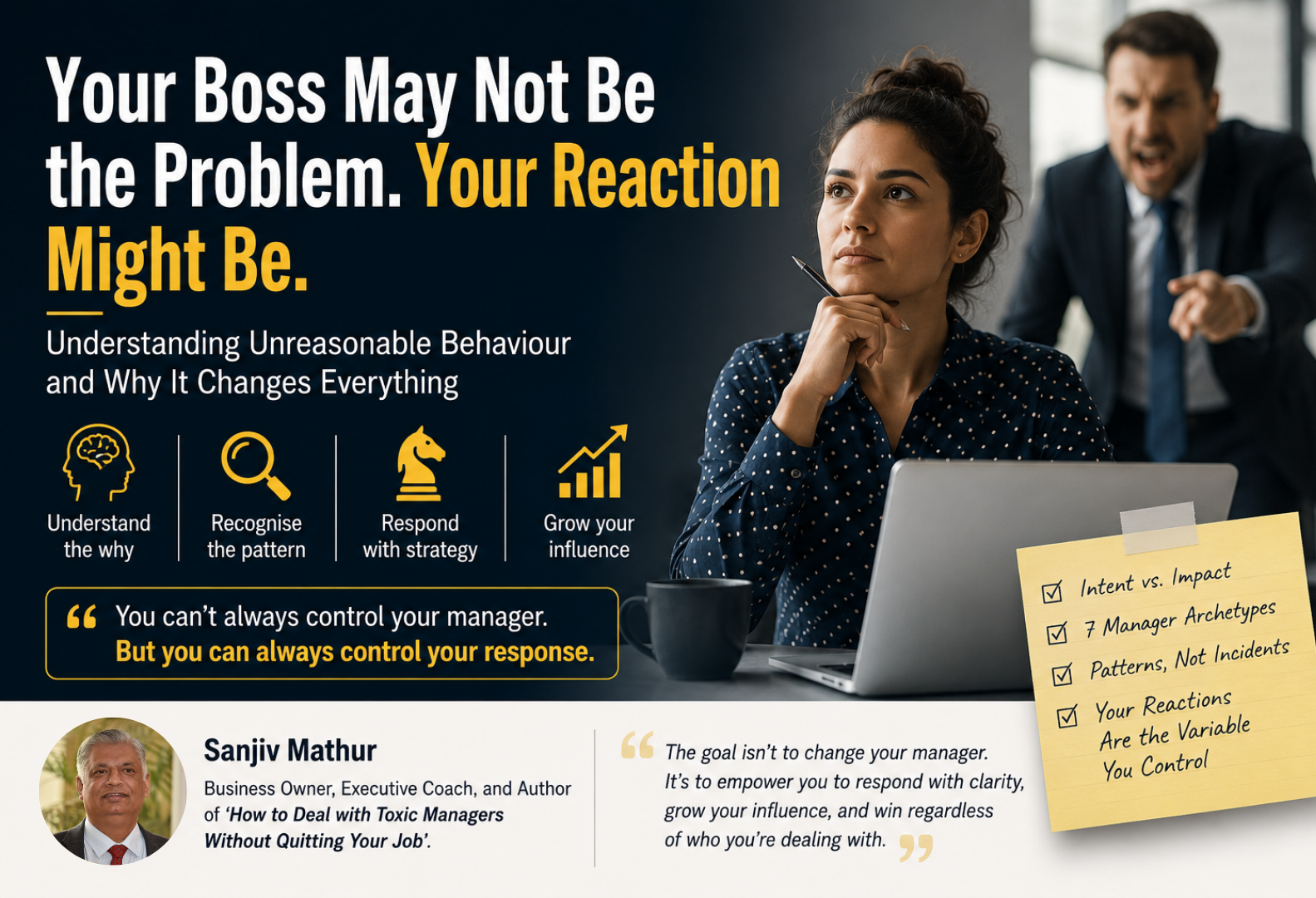
"Understanding Unreasonable Behaviour and Why It Changes Everything"
Let me start with a question most people never stop to ask: do you actually understand why your manager behaves the way they do?
It could be the most important gap in your response mechanism. Because there is a payoff if you do, and that payoff is where your real power lives.
The Toll Nobody Talks About
Most of us have been there. Your Manager is a punk who publicly shames you in a team meeting. He moves goalposts every week, then demands immediate results. He takes credit for your work, ignores your ideas, or makes every interaction feel like a test you're about to fail.
You go home every day, exhausted. Sleep doesn't fix it. You keep thinking it over and over. What could you have done better? Why did they say this, or that? Over time, that kind of environment chips away at your confidence, your motivation, and even your health.
But here's what I've seen again and again in over a decade of executive coaching: the moment someone stops asking 'why is my manager doing this to me?' and starts asking 'why is my manager behaving this way?' the focus shifts.
The Gap You're Missing
The most important thing in dealing with a difficult manager is drawing the distinction between intent and impact. In case you get that feeling, I’m not excusing them or justifying their behaviour. Just making the distinction. Stay with me.
A micromanager who checks in every hour may be terrified that something will go wrong on their watch. Their intent is to protect the work and themselves. The impact on you is feeling mistrusted, under surveillance, and stunted.
A hands-off manager who never schedules one-on-ones may think they're respecting your independence. The impact on you is invisibility and confusion.
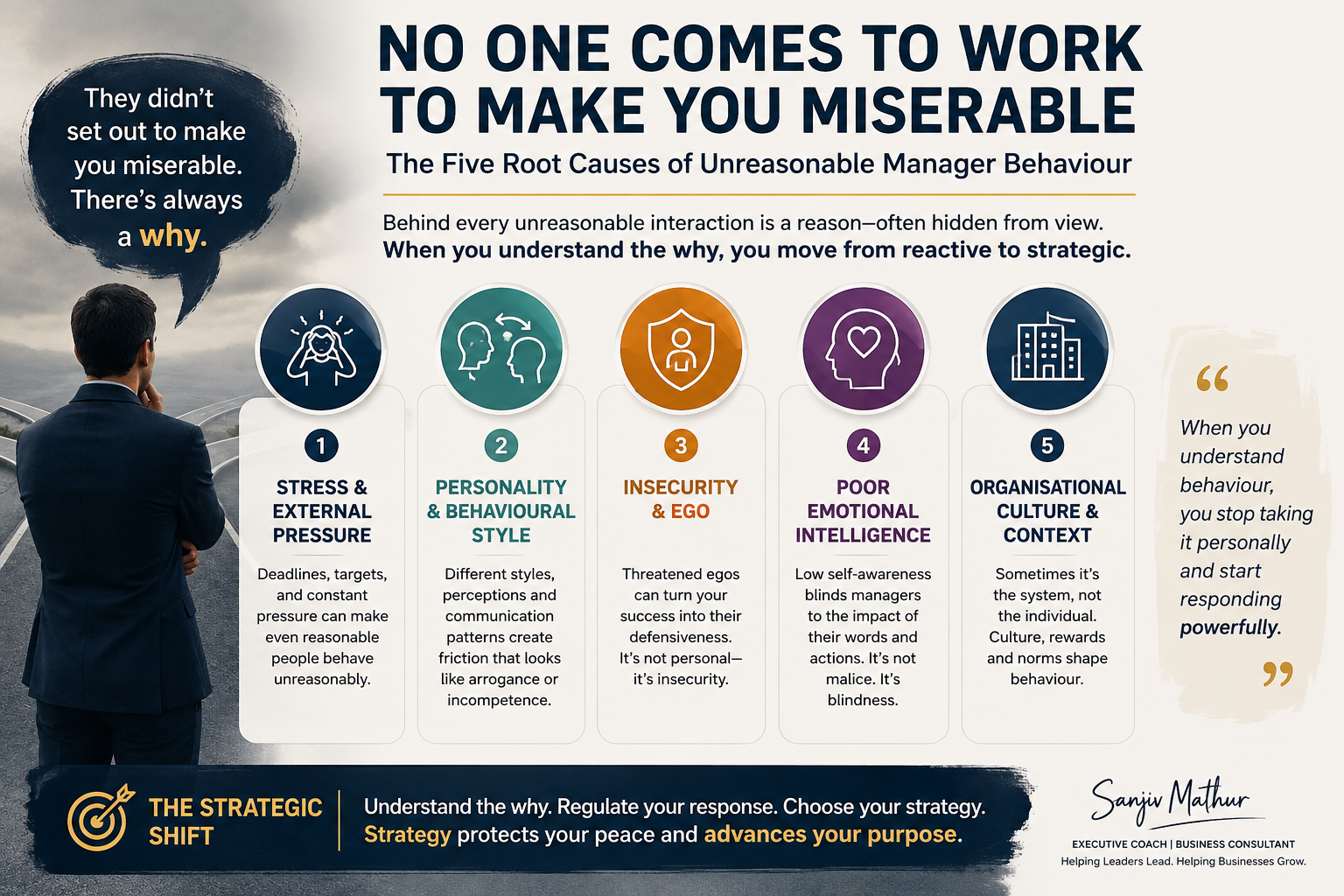
Neither of these managers woke up this morning thinking, 'let me make someone's life miserable today.' Nobody is that dedicated to your suffering. But their behaviour is real, and so is the damage.
Separating intent from impact doesn't excuse poor behaviour. It simply gives you the clearest possible lens for designing your response.
Patterns vs. Incidents
One of the first things I coach people on is this: a single difficult interaction doesn't make a difficult manager. A consistent pattern does.
A manager who snaps at you on the day they learn the company is cutting their budget is a human being under pressure. A manager who consistently snaps at you, undermines you, or dismisses you across multiple situations over sustained time is demonstrating a pattern. That's what requires a deliberate response.
When you can recognise the pattern, you stop being surprised by it. And when you stop being surprised, you stop reacting and start responding with strategy. In your time. On your terms. You regain control.
The Seven Archetypes and Why They Matter
Through years of coaching, I've identified seven recurring types of difficult managers. The Bully. The Micromanager. The Narcissist. The Insecure Manager. The Indifferent Manager. The Overloaded Manager. And the Political Manager.
Each one has different reasons for being who they are. Their triggers are different. The root causes underlying their behaviour are different. And importantly, the strategies you need to use to work with them are also different.
A senior analyst I once coached, had a manager who criticised her publicly in every team meeting. Her first instinct was to defend herself in the moment, That only gave him more material to work with. After a few weeks of coaching, and over several months, she shifted her approach. She documented her work meticulously. She responded to criticism with calm, factual summaries backed by evidence. She appeared more certain of herself because she was not reacting and was giving herself more time to prepare. The attacks lost their intensity. Her standing in the team grew.
The change wasn't in her manager. It was in how she understood him and how she showed up.
Your Reactions Are the Variable You Control
This is the hardest truth in this work, and the most liberating one: your manager is responsible for their behaviour. You are responsible for yours. Including your reactions.
People in difficult manager relationships typically fall into one of three patterns: over-accommodation (absorbing everything to avoid conflict), emotional reactivity (matching fire with fire), or withdrawal (going quiet and ceding all ground). The more you demonstrate a pattern, the worse it gets.
The alternative? Awareness. When you can see your own pattern clearly, you have choices you didn't have before.
Before You Do Anything Else
Take five minutes right now and write down your manager's most consistent behaviour. Focus on patterns, not isolated incidents. Then ask yourself one honest question: is this about me, or is this about them?
Your answer to that question is where everything begins.
Because the goal of this work isn't to change your manager. You have little control over that. It is to empower you. To respond with clarity instead of reactivity. To grow your influence regardless of who you're dealing with.
That's not a small ambition. It's the whole game.
Also Read: 9 Proven Ways to Deal with Toxic Managers Without Quitting.
— ✦ —
"Sanjiv Mathur is a Business Owner, Executive Coach, and Author of 'How to Deal with Toxic Managers Without Quitting Your Job'."




.jpeg)




Comments List