
ICF Coach Educator Competency Framework
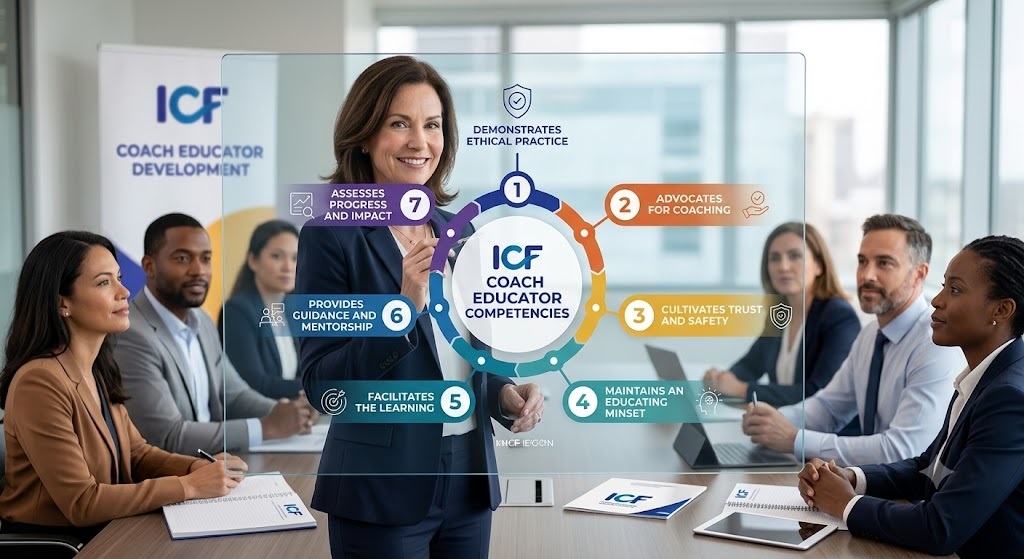
What does it really mean to develop a coach?
The ICF Coach Educator Competency Framework has been making me reflect on a question that sits at the heart of my work as a mentor coach:
Are we developing coaching skills, or are we developing coaches?
There is an important difference.
The framework speaks about ethical practice, continuous learning, curriculum design, inclusive learning environments, educational delivery, guidance and support, and assessing learning.
All of these matter.
But in my experience, the deeper work happens in the spaces between them.
It happens when a coach begins to notice not just what they are doing in a coaching conversation, but who they are being while they do it.
- What happens when I listen?
- What am I assuming?
- What am I not hearing?
- Where am I trying to be helpful?
- What makes me reach for a question, a technique, or an intervention?
- What happens when I stay curious instead of certain?
These questions can take us somewhere that competency checklists alone cannot.
Ethical practice, for me, is not simply knowing what the Code says. It is developing the self-awareness to recognise how my values, beliefs, biases, and patterns can enter the coaching space.
Continuous learning is not simply adding another qualification. It is cultivating the humility to remain a learner, to seek feedback, supervision and mentorship, and to keep examining what I think I know.
Inclusive learning is not simply creating a welcoming room. It is being genuinely curious about the person in front of me and recognising that their context, identity, experiences, learning needs and way of making meaning matter.
Effective education is not simply transferring knowledge. It is creating experiences through which learning becomes embodied.
And guidance and support is not about telling a coach how to coach. It is about creating enough challenge, safety and reflection for the coach to discover their own way of coaching.
This is why mentor coaching is so meaningful to me.
I am not interested in producing coaches who can perform the competencies perfectly when someone is watching.
I want to support coaches in developing the awareness to recognise what is happening in themselves, in the relationship, and in the space between coach and client.
Because eventually, the question is not:
“Did I use the right coaching skill?”
It becomes:
“What was happening in me when I chose to do that?”
And then:
“What did that make possible for my client?”
That shift, from performance to awareness, is where I believe real development begins.
The ICF Coach Educator Competency Framework reminds us that educating coaches is a responsibility that extends far beyond delivering content.
It asks us to model what we teach.
To keep learning ourselves.
To create environments where people can be both challenged and supported.
To offer feedback that builds discernment rather than dependence.
And ultimately, to support the emergence of a coach's own professional identity.
For me, that is the real work.
Not creating coaches who sound like their mentors.
Creating the conditions for coaches to become more fully themselves.
Because the goal of coach education is not simply to know the competencies.
It is to have them become part of how we listen, how we think, how we relate, and how we show up.
When the competencies move from something we know to something we embody, coaching changes.





.jpeg)
Comments List