
No One Comes to Work to Make You Miserable
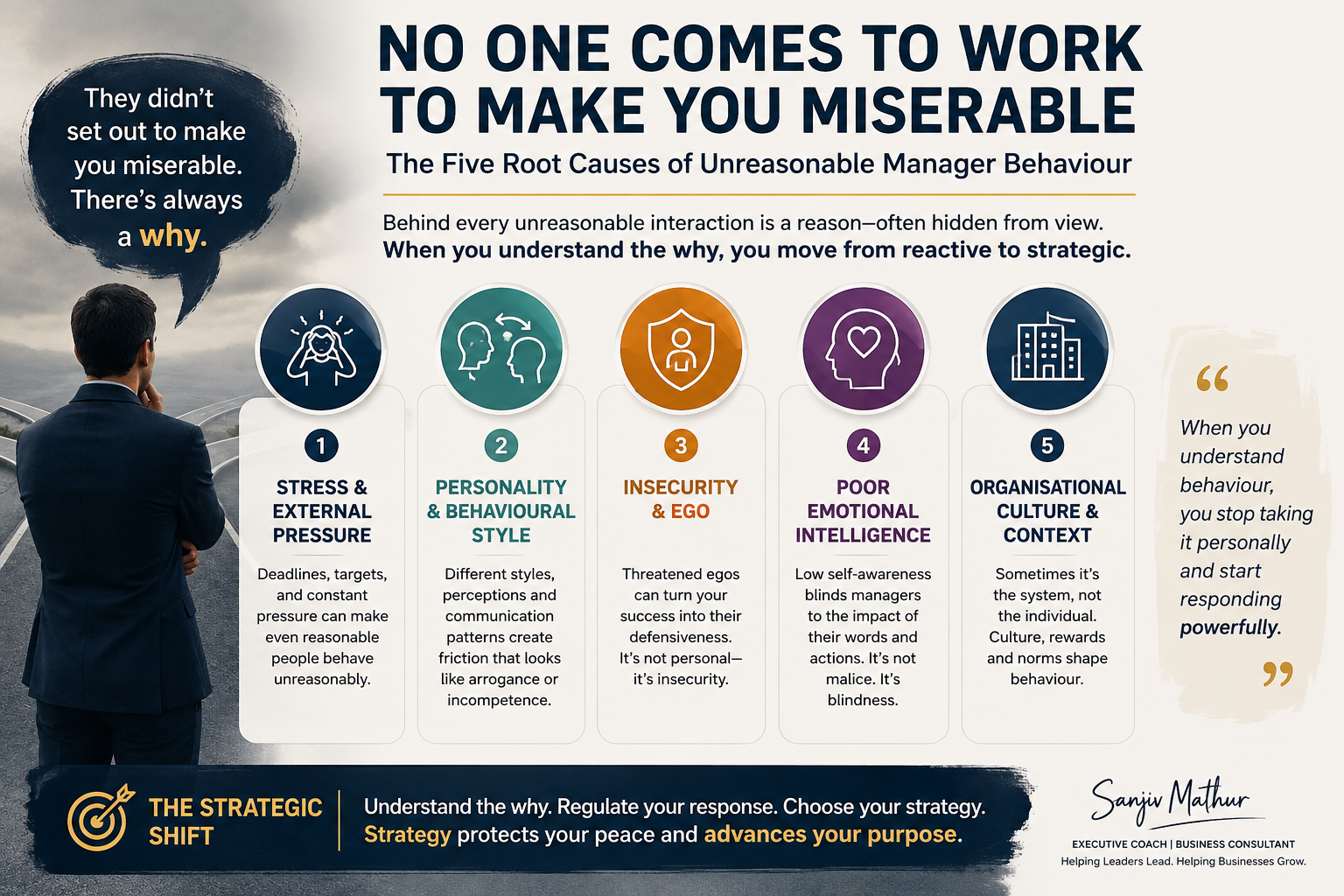
"The Five Root Causes of Unreasonable Manager Behaviour"
Imagine you're in a meeting and your manager cuts you off mid-sentence. Dismisses your idea without letting you finish. The hurt lands immediately, and almost as quickly, turns to anger.
If you're like most people, you spend the rest of the day replaying that moment. And you probably spend very little time asking: why did they actually do that?
Don’t underestimate the potential in that conversation you’re having with yourself. The 'why' is where the shift from reactive to strategic begins. And strategy beats reaction hands down. It leads to solutions based on sound thinking and sound planning. You don’t have to forgive, you just need to have that conversation with yourself, and prepare yourself for the future.
On the other hand, reaction is often episodic, and if you don’t address your own response mechanism for the long term, reactive behaviour will become the go to place even though it solves nothing. It can make you feel heroic at times, but you’ll probably get mugged around the next corner. And it’s a worse spiral if it makes you feel victimized, because it leads you to endless behaviour and language that will attract more of the same.
Are You Trapped In a Cycle?
Every difficult interaction follows a predictable sequence: Thought → Emotion → Action → Result. When anger drives your action, the emotional cost is real and the professional cost is often worse.
The strategic alternative is to decode the 'why' before you respond. And the 'why' almost always points to one of five root causes.
Root Cause 1: Stress & External Pressure
Managers are subject to their own pressure. They carry the added weight of accountability for team performance, their manager's expectations, and targets that may seem impossible to meet. It's true, that’s their job, but they don’t become Superman with the red cape and all just because they have the title and the job. Deadlines and sustained pressure can make even reasonable people behave unreasonably.
When stress is the driver, the rudeness you're experiencing is unlikely to be a personal message about your value. It's more likely a symptom of someone in distress. Understanding that changes the emotional register of your response and opens space for a very different kind of conversation.
Root Cause 2: Personality and Behavioural Style
Modern thinking tends to take a binary view of right and wrong. Vedic and Puranic teaching suggest that although there is one truth, it can be expressed in many valid ways. In the real world, your objectives may be the same but the way you deal with something could be vastly different from the way your manager might. Some managers are naturally direct, blunt, and perfectionistic. Others manage through avoidance or control. When your style and perception collide with your manager's, the friction that follows looks like incompetence or arrogance but is almost always just miscommunication.
Being tone deaf is never a good idea. On both sides. But there’s little you can do about someone else’s behaviour, especially if they’re your boss. Knowing your own style, and genuinely understanding theirs, is one of the highest-return investments you can make into current and future relationships.
Root Cause 3: Insecurity and Ego
A competent team member who asks intelligent questions, produces strong work, or builds relationships with senior leaders can trigger precisely the kind of defensive response that looks, from the outside, like personal animus.
It often isn't. It's a manager who feels threatened by their own team and doesn't have the self-awareness to see it. When you understand that, you stop taking the behaviour personally and start thinking strategically about how to reduce the perceived threat without diminishing yourself.
Root Cause 4: Poor Emotional Intelligence
Nine in ten people in primary research by Inward Focus, my company, believed that high emotional intelligence predicts career success. But only seven per cent rated their own EI as strong. Managers with low EI are frequently unaware of the impact their words and actions have on others. This is not malice. It is blindness.
A chief executive I once coached really liked a product idea his team presented. He confided in me that he would have gone ahead with it 99 times out of 100. Instead, he asked his team if a small change to the product would have an impact. He thought he was pushing for greatness. But his design lead heard rejection. His marketing head mentally scrapped a year's worth of creative work. His sales leader started counting the revenue cost of a delayed launch. The CEO was adding too much value, and he had no idea how his team felt.
Root Cause 5: Organisational Culture and Context
Sometimes the behaviour you're experiencing has less to do with your manager as an individual than with the system they operate within. A manager who sets punishing deadlines may be replicating the culture they were shaped by. A manager who shouts before a major review may be absorbing pressure from above and passing it down.
I worked with a manager who would routinely yell and play tough before major business reviews. When I understood that my manager's pre-review behaviour had nothing to do with me personally, that it was about the pressure the system was placing on him, and the organization’s stated culture of being “hard core”, I stopped absorbing it as a personal message and started treating it as context to navigate.
What the Five Lenses Give You
Taken together, these five root causes give you insights about your manager and the relationship, and they enable you to choose wisely rather than react. Make those choices using your self-awareness, conscience, free will and creative imagination.
When you can see which of these forces is most at work in your situation, you can separate emotion from analysis. You can choose the tactic most likely to work rather than simply reaching for the one that feels most satisfying in the moment. And you can protect your energy for what genuinely matters.
Take one specific behaviour your manager has shown repeatedly. Run it through the five root causes honestly. Which one fits best? That's where your energy belongs first.
— ✦ —
"Sanjiv Mathur is a Business Owner, Executive Coach, and Author of 'How to Deal with Toxic Managers Without Quitting Your Job'."





.jpeg)



Comments List