
What Distinguishes an MCC-Level Coaching Conversation?
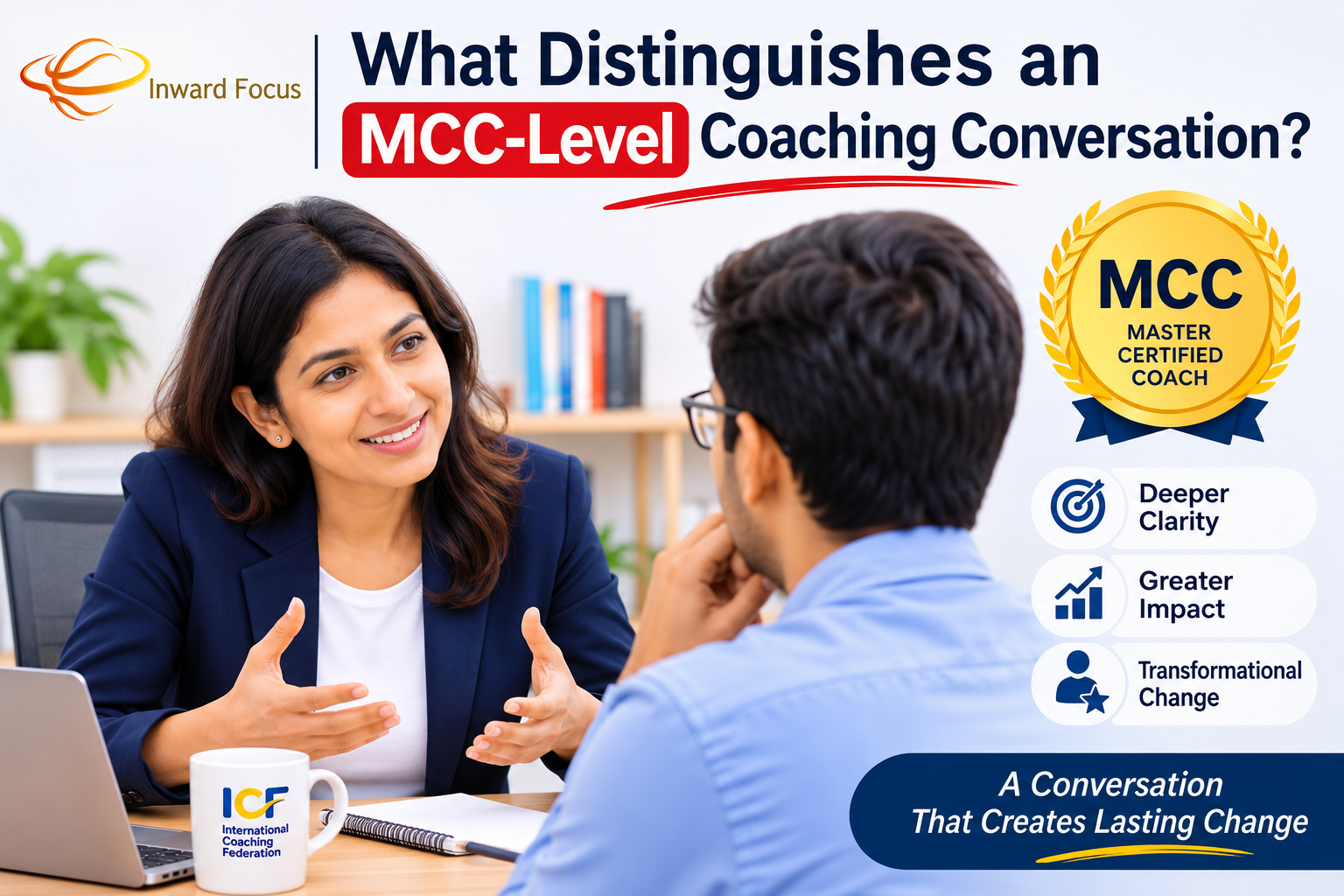
Moving beyond the application of competencies to the deeper art of coaching mastery.
There comes a point in a coach's development when knowing what to do is no longer enough.
You may have studied the coaching competencies, completed your training, accumulated hundreds of coaching hours and developed considerable confidence in your ability to facilitate meaningful conversations. You may even hold a PCC credential.
Yet, as you begin to explore the possibility of becoming a Master Certified Coach (MCC), you may notice something interesting.
The challenge is no longer simply about asking powerful questions, demonstrating active listening or establishing a coaching agreement.
- It is about something much more subtle.
- It is about who you are being as a coach while the conversation unfolds.
This is where the journey towards coaching mastery begins.
Beyond Demonstrating Competencies
Coaching competencies provide an essential foundation for professional coaching. They offer a framework for understanding what effective coaching looks like and how a coach can partner with a client to facilitate learning and growth.
However, there is an important distinction between knowing how to demonstrate a competency and embodying the deeper quality that makes it meaningful.
Consider the skill of asking powerful questions.
A coach preparing for an MCC-level conversation might focus on asking open-ended, thought-provoking questions. They may consciously avoid leading the client or introducing their own assumptions.
All of this is important.
But mastery invites a different enquiry.
- Is the question emerging from genuine curiosity about the client's experience, or is the coach searching for the next powerful question?
- Is the coach listening to what is unfolding, or mentally preparing the next intervention?
- Is the question serving the client's exploration, or demonstrating the coach's capability?
These distinctions may appear small. Yet they can fundamentally influence the quality of a coaching conversation.
At a deeper level, coaching mastery is less about performing the competencies and more about embodying the principles behind them.
The Invisible Dimensions of Coaching
A coaching conversation is influenced by much more than the words exchanged between coach and client.
The coach brings an entire internal world into the conversation.
This includes:
- Beliefs about people, change and human potential.
- Emotional responses to what the client shares.
- Assumptions that influence what the coach notices.
- Personal preferences and patterns of thinking.
- The ability to remain present when uncertainty emerges.
- The willingness to let go of the need to direct the conversation.
These internal dimensions are not always immediately visible. Yet they influence what the coach hears, how the coach responds and what becomes possible in the partnership.
This is an important principle explored in my work through Coaching the Invisible.
The visible quality of a coaching conversation is influenced by the invisible inner world of the coach.
Two coaches may ask exactly the same question. However, the quality of their presence, the intention behind the question and their capacity to remain open can create very different experiences for the client.
The question itself is only one part of the conversation.
The coach behind the question matters just as much.
The Role of Coaching Presence
One of the more subtle aspects of coaching mastery is presence.
Presence is not simply about being attentive, maintaining eye contact or demonstrating that we are listening.
It is the capacity to be fully available to the client and to what is emerging in the moment.
This requires the coach to be aware of their own internal responses without becoming controlled by them.
For example, imagine a client who repeatedly returns to the same concern.
The coach may experience frustration, impatience or an urge to help the client move forward.
These reactions are human. They are not necessarily a problem.
The important question is whether the coach recognises what is happening internally and can remain available to the client rather than allowing the reaction to determine the direction of the conversation.
This is where self-awareness becomes central to coaching mastery.
The coach must be able to notice their internal experience without making it the centre of the conversation.
From Competence to Discernment
As coaches develop, their relationship with the competencies can evolve.
Initially, there may be a conscious effort to remember and apply specific skills. With experience, these skills become increasingly integrated.
But mastery involves something beyond automatic application.
It involves discernment.
Discernment is the ability to recognise what is needed in a particular moment, what is not needed and when doing less may create more space for the client.
A masterful coach does not need to fill every silence, offer an insight at every opportunity or demonstrate the sophistication of their thinking.
- Sometimes, the most meaningful contribution is to remain present.
- Sometimes, it is to notice a shift in the client's energy.
- Sometimes, it is to explore what has not yet been expressed.
- And sometimes, it is to resist the temptation to intervene.
This is not passive coaching. It is an active, conscious choice grounded in awareness and partnership.
The Coach Must Continue to Develop
One of the misconceptions about coaching mastery is that experience alone will naturally lead to it.
Experience is valuable, but experience without reflection can reinforce existing patterns.
A coach may become increasingly skilled at doing what they already know how to do, without necessarily examining the assumptions and habits influencing their coaching.
Developing mastery therefore requires a willingness to turn attention inwards.
Questions worth exploring include:
- What happens internally when my client challenges me?
- How do my beliefs influence what I hear?
- What am I attached to in this conversation?
- Can I remain curious when I do not know where the conversation is going?
- Am I genuinely partnering with the client, or subtly directing the process?
- What might I be missing because of my own assumptions?
These questions are not simply reflective exercises. They invite a deeper relationship with the practice of coaching.
The Journey Towards MCC
The journey towards the MCC credential is an opportunity to examine coaching at a deeper level.
It invites experienced coaches to look beyond the mechanics of coaching and explore the quality of their presence, awareness, partnership and discernment.
Technical capability remains important. But the evolution towards mastery also involves developing the person behind the professional skills.
At Inward Focus, this is central to our approach to MCC mentoring.
We work with coaches not only on their understanding and application of coaching competencies, but also on the deeper internal awareness that influences how they show up in a coaching conversation.
Because coaching mastery is not simply about becoming better at asking questions.
It is about developing the capacity to listen more deeply, see more clearly and create the conditions in which clients can discover their own possibilities.
The question to reflect on is this: Are you becoming more skilled at coaching, or are you also developing the coach behind the skills?
That distinction may be one of the most important steps in your journey towards mastery.
About the Author
Sandhya Mathur, MCC, is an MCC Mentor Coach, Leadership Coach, Coach Educator and Founder of Inward Focus. She also serves as Director of Education at Symbiosis Coaching, contributing to international coach education, mentor coaching and ICF credential development.
She specialises in MCC mentoring, coaching mastery, emotional intelligence and coaching presence. Integrating neuroscience, EQ, mindfulness and Eastern wisdom, she helps experienced coaches develop the internal awareness and discernment that distinguish coaching mastery.
She is the author of Coaching the Invisible, a bestseller that encapsulates her inside - out coaching philosophy , connecting neuro science, emotional & spiritual intelligence.
"Sandhya" has authored ICF approved programs that are a part of the curriculum in at Symbiosis Coaching USA.
Explore MCC mentoring and coach development programmes at Inward Focus.




Comments List